State Awards

Traditional livestock healer

State Awards

The renowned Pashu Vaid

Becharbhai has, for the past 55 years, been practicing traditional veterinary medicine in about 60 villages in Patan, Siddhpur and Deesa talukas. Becharbhai states that he did not learn the science of healing animals from any individual. He acquired his expertise through his observation and understanding. He is adept at treating fractured limbs of any animal. Whatever be the kind of fracture, he gets the animal up on its feet in a very short time. He also treats diseases like polio, paralysis, bloat, tumour, retention of placenta, horn cancer, prolapse of uterus, maggot infestation in wounds abnormal foetal position and problematic pregnancy/calving. The most remarkable thing about him is that he never charges for his services. The client just needs to arrange for his transportation.

Manual Milking Machine

State Awards

Raghava has developed an elaborate, refined milking machine that can milk cows and buffaloes using a set of reciprocating vacuum pumps with a vacuum gauge, a suction assembly unit and an air bubble free well gasketed milk canister to receive the milk. The suction assembly has two sub-assemblies with a set of nipples and stainless steel plate on one side and transparent conduit pipes and a regulator valve on the other.

Each of the sub-assemblies are taken apart for cleaning before and after every milking operation.The udder and teats of the cow are also washed with cold water and wiped using cotton cloth. The hand lever attached to the pumping unit is cranked till a vacuum of 200-250 inches is created in the suction–nipple unit. This is attached to the udders and the milk gets deposited in the receiving canister via the transparent conduit pipes. When air bubbles flow along with the milk, the operation is stopped and on gently pressing the top of the teats, the teats get released. The control valve and vacuum pressure gauge, located on the main pumping unit, control the suction circuit and the milk receiving canister via the transparent conduit pumps. The four nipple suction configuration can alternate pulsations between two sets for the operation for facilitating milk flow and reducing milking time.

Dual purpose Rotary Huller

State Awards

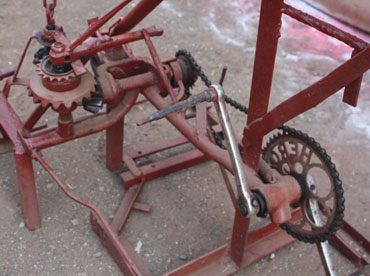
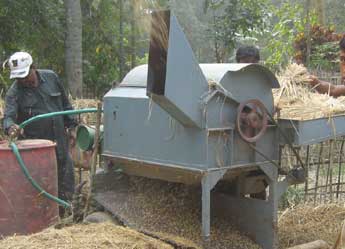
The rotary huller developed by Manoharan is an ingenious system that can be used to hull small quantities of different items simultaneously. This machine uses the principle of the inherent gravitational force of falling bodies to do the hulling, without using any electricity or fuel.

The machine can be operated manually as well as electrically. Since the hollow tubes are individual and discontinuous, six different varieties of items such as spices, cereals, rice and other grains may be hulled simultaneously. But in other grinding machines and mechanical hullers only one product can be ground at a time. In this rotary huller, the hulling operation does not produce much heat so the original flavor of the product is maintained. In the conventional grinding machines, due to high friction, a significant degree of heat is generated, which spoils the natural flavor and the chemical composition in the case of medicinal plants and roots. The machine is easy to operate and requires very little maintenance. This device has a number of applications such as, grinding herbal and non-herbal products for medicines, grinding animal waste to produce fertilizers, producing animal fodder, and mixing and grinding all types of grocery items. At Rs.5000, this device costs one third of the cost of the nearest comparable mechanical huller available in the market. The output is about 3kg/hour for hard grains and 18 kg/hour for cereals. This energy efficient device is a good tool to increase mechanization in rural areas. Since it is easy to operate, women can take over the job of hulling, and eliminate the drudgery of manual hulling. The rotary huller also caters to the expectations of the consumer segment that believes in the superior quality of a product that is pounded by hand.

Zero Head Hydro Turbine

State Awards

Kalita has designed two variants of turbine and pump models. Initially he had developed a water turbine using bamboo for harnessing the flow energy from the river to pump water to his land way back in 1998-99. And later with the assistance from GIAN-NE, a voluntary organization working in the field of development of grass root innovations, he has developed another version of the same turbine.

First model

The first model had a spiral offset arrangement of blades. In this the blade axis is perpendicular to flow direction. The offset arrangement of blades provides constant thrust to the system. In conventional water wheels, thrust is available only once when blade is perpendicular to the flow direction. In the present arrangement it is similar to multi cylinder crank arrangement in which the turbine will get thrust constantly from blades. The offset arrangement also provides sufficient clearance between blades so that floating debris will not clog the blades. Since the path of the water takes spiral shape from entrance to the exit, the arrangement of blades acts as screw conveyor. This facilitates the debris to pass on from entrance to exit, which facilitates smooth running of the turbine. The arrangement of the baffle operated pump, which acts as a submersible pump facilitates the lifting of water. The cost of the complete system is only about Rs.3, 000 including labour cost which is quite affordable by small farmers.

Wood Based Low Cost Environment Friendly Cremetorium

State Awards

This crematorium is an improvisation over the normal Open Wooden Pyre Crematorium (WPC). It appears to be “a hybrid concept” of electric and open type crematorium. By providing a small chamber and closing it with thick walls (insulator), the crematorium generates high temperature around the human body which is sufficient to turn it to ashes in an hour and fifteen minutes. The whole structure is around 50 ft in length and 30 ft in width at its widest part. It is divided into a hallway in the middle, a rest room at one end and the room that houses the crematorium itself, at the other end. The crematorium room is around 14 x 14 feet with the crematorium in the middle. It is a longish structure that is open at one end and connected to a 36 feet high chimney at the other. The chimney has a cover that can be operated from outside to control the heat and the intensity of the flames inside the oven. For the free flow of air, there are two small openings at both sides. The structure is around five feet high and eight feet long. It has a lining of fire resistant bricks and is covered with five removable iron sheets. Along the bottom there are five removable iron grills with the same number of iron plates below them. Below ground level, the space has been filled with locally sourced granite stones up to a depth of around six feet.

XML feed