National Awards

Fungal control in honey bee

National Awards

The medicine

It consists of aloe, tulsi, turmeric and Spreng(Plectranthus amboinicus) in a sugar solution as bees will take it only if it is sweet. The medicine is placed in a bowl, on the top of the box in which the colony lives, with a towel soaked in it and the medicine drips out through the sides of the towel which overlap the bowl. When the bees start bringing pollen again it is a signal that the colony is healthy and that the queen has started laying eggs.

This is a completely herbal medicine; hence there are no harmful effects for the bees or any contamination to the honey. The cost of medicine for curing a diseased colony in one box would be about Rs.150 and this is quite cost-effective when one considers that during peak season from December to April one can harvest as much as 15-20 kg of honey from a box and sell it at a price of about Rs.60/kg. In addition, during peak season, a colony would fetch a price of about Rs.800.

Propagation of rubber by budding

National Awards
Young budding is an economically viable technique which can be applied on a commercial level as a method of vegetative propagation in rubber. High quality seeds are planted in polybags during July-August and budding starts from the 28th day and can continue up to the 60th day. The bud sticks are 20-25 days old. After 15-20 days budding success is assessed and the plants are retained in polybags for 5-6 months. The stock plant is cut back at 8-10 cm from the bud patch during January and after 10 days a new plant starts growing. About two gram of NPK mixture in liquid form is applied monthly apart from regular watering. Four months after this the saplings are ready to be transplanted to the field.

HMT- an Improved Paddy Variety

National Awards

The paddy variety

Dadaji Ramaji selected and bred the HMT rice variety from the conventional ‘Patel 3’, a popular variety of that time developed by Dr. J. P. Patel, JNKV Agriculture University, Jabalpur. He succeeded after five years of continuous study and research on a small farm owned by him without any support from the scientific community. It has an average yield of 40 – 45 quintals per hectare with short grains, high rice recovery (80 %), better smell and better cooking quality in comparison with the parent ones.

Septic Tank Baffle System - An Effluent Filtering Device

National Awards

The ingenuity behind the innovation holds the listener’s attention. The septic tank is a combined sedimentation cum digestion tank where household sewage is treated. The lighter solids including grease and fat rise to the surface to form “scum” and the heavier solids settle down in the tank to form “sludge” which is gradually decomposed by bacteria. The liquid waste or effluent goes into the drain field and undergoes oxidation. The baffle helps to reduce the disturbance of the settled sludge and keep the solids and scum in the tank. In the conventional septic tank, two baffles made of concrete are used. However, in Rajesh’s innovation, only one baffle made of PVC pipes is necessary. This circular baffle which consists of three chambers works as a divider and filter.

Boiled Tea Making Machine for Customised Taste

National Awards

This machine facilitates the Indian method of making tea by separately pumping in water, adding tea-leaves and sugar, heating, adding milk, boiling and filtering, and dispensing the tea automatically into cups in pre-assigned proportions. Each user can set these proportions according to his/her taste. Apart from putting the cups and setting the number to deliver up to four cups, the entire tea making process is automatic and the cups are laid out on a sliding tray once the tea is ready. It produces four cups of tea in five minutes and can be used as many times in a day as required.

Manual Wood-Cutting Machine

National Awards

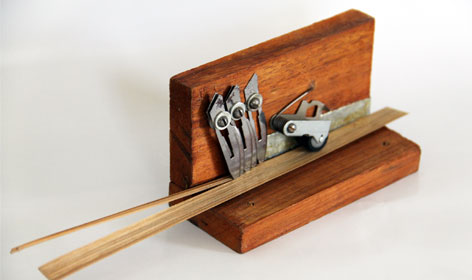
The manual wood cutting machine is an energy saving device that works on the principle of inertia of motion. The machine can be used to cut big logs as well as wood for furniture .

Details of the latest prototype

Construction details

Wood has been used as the structural material. Some parts are made of steel and RCC. The height of the machine ranges from 5-10 ft. It consists of two wooden columns on which steel channels are fitted, a Bed, two Fly wheels made of composite material i.e. steel and RCC, two connecting rods made of wood, cutting blade, flexible clamp made of iron and eight Ball bearings.

Modified Fan Design Made of Bamboo

National Awards

The innovators have developed a multi-bladed, double-layer fan to blow air in order to separate rice and husk when the mixture falls from the rice de-husking and winnowing machine. This unique fan is made of bamboo. Unlike normal fans that have one set of blades circumferentially on the axis, this machine has two sets of larger and smaller blades located circumferentially in the same axial shaft. The bigger blades are eight in number, straight and small in width. The four curved, smaller blades are arranged next to the bigger blades.

The curvature provided to the front blades, which are smaller, helps in sucking the air due to the creation of a vortex and this feature is attributed to the Coanda Effect .The Coanda Effect is the tendency of a stream of fluid to stay attached to a convex surface, rather than follow a straight line in its original direction. The effect is named after Henry Coanda, a young Romanian Engineer who used the principle to power an aircraft in 1910.

Matchsticks of Natural Fibre

National Awards

US Patil has successfully developed a process of making splints for safety matches using some natural fibres. The natural fibres are bound by natural starch to give it the required thickness and strength. This is then coated by some natural oils to provide the final finishing. The fibres thus obtained are then cut to the required length/size. After cutting the threads they are dipped into the phosphorus solution to coat the tips with the igniting material.

In comparison with conventional matchsticks these matchsticks burn longer. The matchstick burns slowly but steadily, reducing the chances of the user’s fingers being burnt. Further no harmful chemical is used except the mandatory phosphorus. Preparing these matchsticks is much easier and cheaper than preparing wooden matchsticks which require huge machinery for cutting logs of wood to suitable size. The innovation has a significant impact on the environment and can also change the dynamics of the safety match industry. NIF in coordination with GIAN- West has sanctioned an amount of Rs. 12,500 from its Micro Venture Innovation Fund towards laboratory testing and technology transfer of the matchstick. NIF has also filed the patent and the number is 345/MUM/04, 22.03.04.

Scooter for the Physically Challenged

National Awards
Video |

Basically this is an assembled scooter with the chassis and engine being that of Bajaj Priya and the outer body of Bajaj Chetak. The scooter has two support wheels (Modified Luna supports) on either side for balancing the vehicle. A removable seat has been fixed in front of the usual driver seat for Dhanjibhai to reach the handle bars. A lever has been attached to the rear wheel brake, for the driver to be able to apply the brakes with his hand. The rear two wheels are kept a little higher so that the vehicle does not skid. With this set up the driver is able to conveniently drive the vehicle and reach a maximum speed of 60-70 km/ hour.

Variable Gear System for Cycle Rickshaws

National Awards

The principle employed in the gear-system developed by Jabbarbhai is similar to the double sprocket system, where two free wheels are used. Free wheel is a simple but indigenous mechanism which allows rotation in one direction and becomes free in the reverse direction. Jabbarbhai used this mechanism and converted it into a gear system. He devised a mechanism in which the gear is changed or engaged with the help of a dog-lift, which can be activated by the rickshaw-puller with the help of the lever attached to the handle. As soon as the puller pulls the string, the dog-lifter is released and the cam gets released- it moves up and in turn gets locked with the teeth inside the free wheel and thus the gear is engaged. Once the vehicle gains some motion, the puller shifts to second gear.

XML feed